Diminished Value When No Comparable Cars Exist
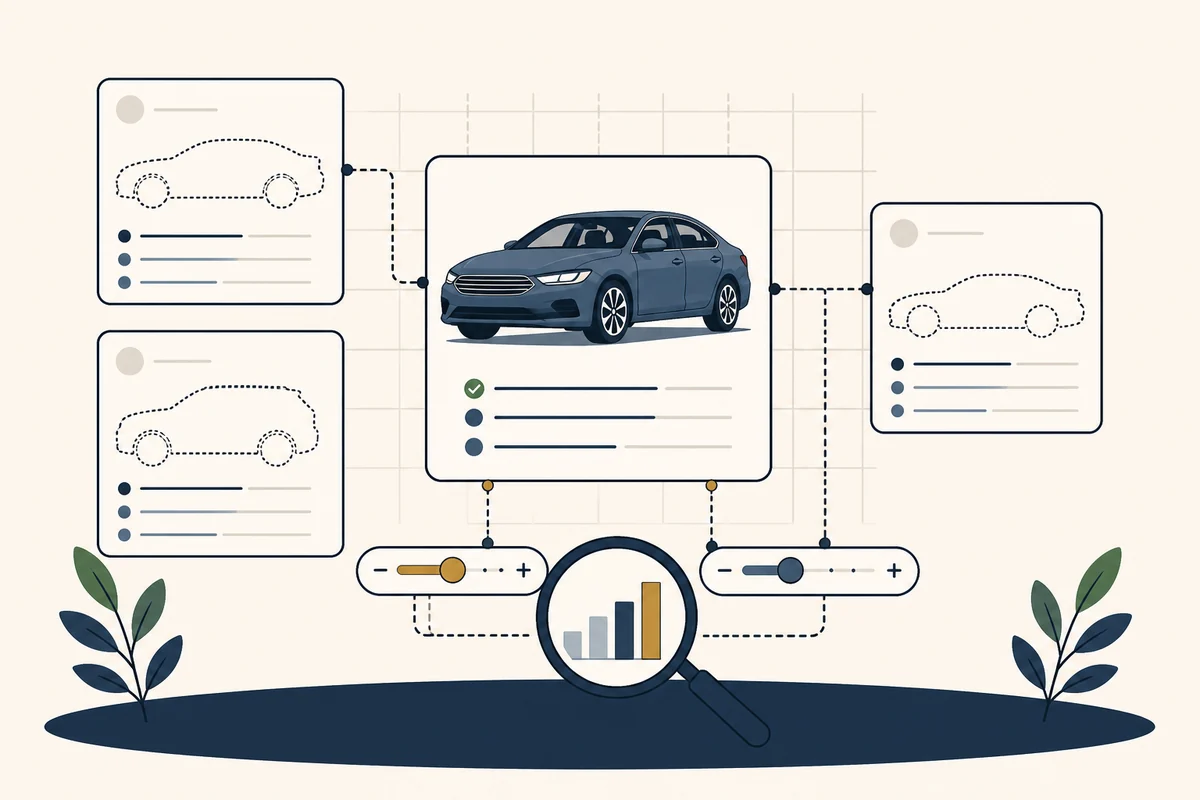
Do not invent an exact comparable or default to one formula. Establish the pre-loss vehicle and market first, then broaden the comparison in controlled steps: wider geography, adjacent model years or trims, paired clean-versus-accident evidence from the closest market segment, disclosed dealer offers, and a qualified appraisal. Document every adjustment and uncertainty.
Scope: General educational information, not legal advice or an appraisal. Claim rights, deadlines, policy language, evidence rules, and recoverable amounts vary by jurisdiction and facts.
Why an exact match may not exist
A current-model vehicle may have almost no used inventory. A new trim, limited-production model, specialty configuration, or EV in a rapidly changing price market can have too few local examples. Accident-history filters may be incomplete, and listings may not disclose comparable repair severity. That does not justify pretending weak matches are exact.
A recent community thread asked this precise question about a 2026 vehicle with no used version of the same trim. The question is useful audience evidence; the answers are opinions. For factual grounding, the NAIC study says there is no consistently accepted standard formula and that local market, pre-loss condition, damage, repair history, and professional judgment all matter.
Separate the two valuation questions
- What was this vehicle worth immediately before the accident? Establish the loss-date baseline from the closest reliable market evidence, not automatically MSRP, the loan balance, or today's replacement price.
- What market penalty remains after repair? Measure how accident history and the documented repair affect otherwise similar vehicles, with adjustments for differences.
Keeping the questions separate prevents double-counting ordinary depreciation, incentives, mileage, or market-wide price movement as collision loss.
Use a controlled evidence ladder
- Exact local matches: same model year, trim, drivetrain, equipment, mileage band, seller type, and history.
- Exact wider-market matches: expand geography and then adjust transport costs and regional pricing.
- Adjacent model year or trim: use the closest configuration and document equipment, powertrain, warranty, refresh, and price differences.
- Paired segment evidence: examine clean-history versus accident-history pricing in a closely related configuration to estimate a market reaction, then explain why it transfers imperfectly.
- Disclosed purchase or trade offers: obtain multiple offers using accurate accident and repair information; distinguish an offer from retail value.
- Qualified appraisal or dealer research: use a professional who will show contacts, data, exclusions, adjustments, and uncertainty.
- Formula sensitivity check: calculate a disclosed formula only as a comparison point, never as proof that it controls the claim.
Stop broadening when the differences overwhelm the signal. An honest range may be more defensible than a false single-dollar precision.
Track every adjustment
| Difference | Evidence to save | Risk if ignored |
|---|---|---|
| Mileage | Odometer, listing mileage, mileage-date relationship | Attributes ordinary use to the accident |
| Trim and options | Window sticker, build data, equipment list | Compares materially different vehicles |
| Time | Listing date, loss date, incentives, market index if used | Mixes market movement with collision loss |
| Geography | Dealer location, transport, regional demand | Imports a price from a different market |
| Seller and price type | Dealer/private/auction; ask/offer/sale | Subtracts unlike price concepts |
| Damage history | History entry, repair scope, prior loss | Treats all accidents as equally severe |
Write the no-comparables explanation into the report
State the search dates, platforms, radius, exact filters, number of results, excluded vehicles, and why they were excluded. Then show each expansion step and adjustment. If only clean-history examples exist, say so; do not create the post-repair value by subtracting an unexplained percentage.
For example: "No same-trim, accident-history vehicles were located within 250 miles as of the valuation date. The analysis therefore used four exact-trim clean-history listings to establish a baseline, then examined three accident-history vehicles in the adjacent trim to estimate a range. Equipment and mileage differences were adjusted separately. The resulting range is less certain than an exact matched set." This is a method illustration, not a valuation conclusion.
Be careful with MSRP, purchase price, and formulas
MSRP is a manufacturer's suggested retail price, not proof of the loss-date used-market value. A recent purchase can inform the baseline but may include taxes, fees, add-ons, financing effects, scarcity premiums, or incentives. A loan balance measures debt, not market value.
The NAIC study describes 17c and notes that its mileage modifier may duplicate mileage already reflected in the base value and that it does not inspect post-loss repair quality. Use the site's 17c and market-evidence calculator to understand the math and test assumptions, not to label the result universally correct.
When a professional adds the most value
A qualified appraiser may help when the vehicle is rare, the date-of-loss market moved sharply, the repair is specialized, prior history needs to be isolated, or a defensible adjustment model is beyond what you can document. Ask for the full dataset and method. Scarcity makes expert judgment more important, not less accountable.
See how to vet a diminished value appraisal before paying.
Frequently asked questions
Can I use a different trim as a comparable?
Yes, if it is the closest available evidence and you disclose and support the trim, equipment, powertrain, warranty, and market adjustments. Do not label it an exact comparable.
Can I use vehicles from another state?
You can broaden geography when local supply is insufficient, but explain regional demand, taxes or fees if relevant to the price concept, transport, weather, incentives, and seller differences.
Is MSRP the pre-accident value of a brand-new car?
Not automatically. Use loss-date market evidence and explain how the transaction price, incentives, fees, mileage, and availability affect the baseline.
Should I use 17c when there are no comps?
It can be disclosed as a screening or sensitivity calculation. The NAIC research identifies material limitations and does not treat it as a universal standard.
What if I can find clean cars but no accident-history cars?
Document the failed search, then use the controlled evidence ladder: related configurations, disclosed dealer offers, broader markets, or a transparent professional analysis. Present uncertainty rather than an invented discount.
Related diminished value questions
Research sources
- Primary research: NAIC Journal of Insurance Regulation: Automobile Diminished Value Claims (2023)
- Community question: Reddit: How do I value a new car when no used comparables exist?