Diminished Value Claim Documents: What to Submit
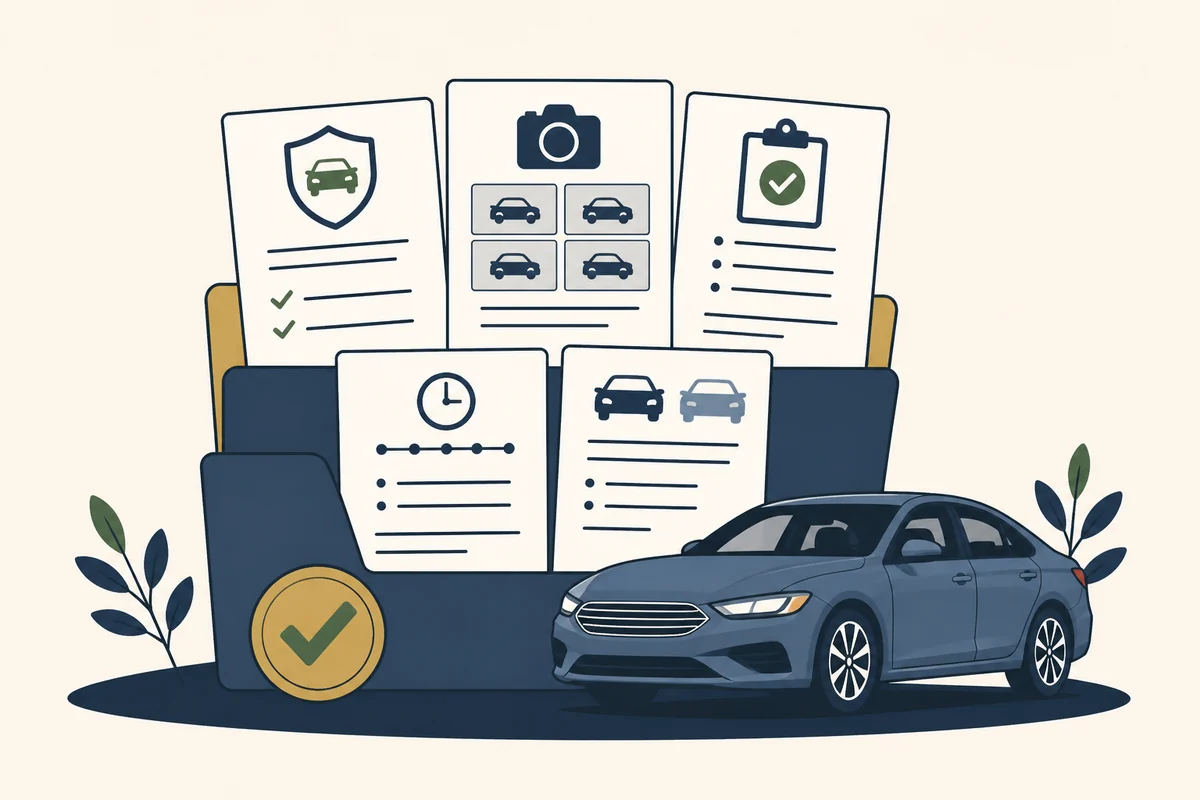
Submit an indexed packet that proves the correct claimant and claim path, the vehicle and completed repairs, its pre-loss baseline, and the post-repair market loss you are claiming. Photos and a repair bill explain what happened; they usually do not, by themselves, prove how much market value remained lost.
Scope: General educational information, not legal advice or an appraisal. Claim rights, deadlines, policy language, evidence rules, and recoverable amounts vary by jurisdiction and facts.
Start with a one-page claim summary
Make the first page easy to route and review. Include the claim number, loss date, vehicle year/make/model/trim and VIN, current mileage, claimant name, claim path, date repairs were completed, amount requested, and a one-paragraph explanation of the valuation method. Follow it with a numbered enclosure index.
Do not bury the request in a folder of unlabeled images. The current community question that prompted this guide asked whether before-and-after photos and the repair cost were enough. They are important, but the NAIC study says the claimant bears the proof burden and identifies market, history, condition, damage, and repair factors beyond cost alone.
Ownership and vehicle identity records
- Registration or title evidence showing the vehicle and claimant.
- Lienholder or lease information when relevant to who may present or receive the claim.
- VIN, exact trim, drivetrain, factory packages, major options, and current mileage.
- Pre-loss condition and maintenance records when they materially support the baseline.
- Prior-accident, prior-repair, title-brand, fleet, rental, or commercial-use history.
Redact bank account numbers, unrelated driver's-license data, and other sensitive information the recipient does not need. Keep unredacted originals in your file.
Accident, liability, and claim-path records
- Police report, driver exchange, incident report, or other reliable loss record.
- The insurer's written liability position, if one exists.
- Claim number, adjuster contact, and policy or coverage correspondence relevant to this property claim.
- Your own declarations and relevant policy language if you are making a first-party or UM/UIM property-damage claim.
Keep injury, medical, wage, and unrelated personal records out of a vehicle-market-value packet unless a qualified adviser identifies a specific need. A clean property file reduces confusion and unnecessary disclosure.
The complete repair file
- Initial estimate, every supplement, final detailed repair order, and paid or final invoice.
- Dated photos before repair, during disassembly or structural work, and after completion.
- Parts type and replacement records, scan reports, calibration records, alignment or structural measurements, and sublet invoices when relevant.
- Documentation of any unresolved condition, comeback repair, warranty work, or post-repair inspection.
The final file matters more than the first estimate because disassembly often changes the scope. Separate evidence of accident-history stigma from evidence that a repair defect remains.
Pre-loss and post-repair market evidence
Label each item by the question it answers:
- Pre-loss baseline: dated valuation guides, matched clean-history listings or transactions, purchase records if recent and representative, and condition evidence.
- Post-repair value: matched accident-history comparables, written dealer or online purchase offers that accurately disclose the collision, and any qualified appraisal.
- Adjustments: a worksheet explaining mileage, trim, options, condition, geography, seller type, date, and history differences.
- History: relevant vehicle-history or claims-history records, with a note that any one database may be incomplete.
The NAIC study identifies local market conditions and comparable vehicles as important, while also emphasizing that no standard national formula exists. Save URLs, access dates, VINs when available, screenshots or PDFs, and whether a number is an asking price, offer, wholesale result, or completed transaction.
A packet structure an adjuster can audit
| Section | What it proves | Example filename |
|---|---|---|
| 1. Summary | Request, amount, claim path, and enclosure map | 01-claim-summary.pdf |
| 2. Identity | Vehicle, claimant, trim, mileage, and history | 02-vehicle-and-ownership.pdf |
| 3. Loss | Accident, liability position, and claim reference | 03-loss-and-liability.pdf |
| 4. Repairs | Actual completed repair scope and condition | 04-final-repair-file.pdf |
| 5. Market | Before-and-after value evidence and adjustments | 05-market-evidence.pdf |
| 6. Demand | Requested resolution and written response date | 06-demand-and-delivery.pdf |
Use descriptive filenames, consistent page numbers, and one delivery method you can prove. Keep a read-only copy of exactly what was sent.
What is usually not enough by itself
- A repair total with no market analysis.
- Before-and-after photographs with no valuation evidence.
- A generic book value that does not separate clean and accident history.
- A 17c result presented as the universal measure.
- One unmatched listing or one unexplained trade offer.
- A report that announces a percentage without disclosing data and adjustments.
Use the site's private evidence checklist and demand letter builder to organize the packet; review every generated statement for accuracy before sending it.
After you upload the file
Ask for written confirmation that the submission is complete, the name of the person evaluating it, any missing item, and the method and source data used in the response. Preserve the upload receipt, email headers, portal confirmation, and every later version. If the insurer disagrees, a clear original packet makes a line-by-line counter possible.
Frequently asked questions
Can I submit a diminished value claim before repairs are complete?
You can preserve records and ask about the process early, but a post-repair inherent-loss amount is usually easier to evaluate after the final repair scope and condition are known. Do not assume one timing rule applies in every state or policy.
Do I need a CARFAX report?
Not universally. A vehicle-history report may help document an entry, but databases can be incomplete and do not measure the amount by themselves. Use all reliable history and market evidence available.
Should I include medical records?
Ordinarily, vehicle diminished value is a property valuation issue. Avoid adding sensitive unrelated records to the packet unless a qualified professional identifies a specific reason.
Are screenshots acceptable evidence?
They can preserve a listing, but capture the URL, date, seller, VIN when available, mileage, trim, history, and full price context. A cropped price with no source is weak.
How many comparable vehicles do I need?
There is no universal count. Use enough genuinely comparable observations to show a pattern, disclose the search method, and explain differences rather than padding the file with weak matches.
Related diminished value questions
Research sources
- Primary research: NAIC Journal of Insurance Regulation: Automobile Diminished Value Claims (2023)
- Community question: Reddit: What supporting documents should I upload?